

How to Deep Clean a Bathroom: Step-by-Step Guide
Researched by the Houmse team · Published June 2026 · Updated October 2026 · 9 min read · Editorial standards
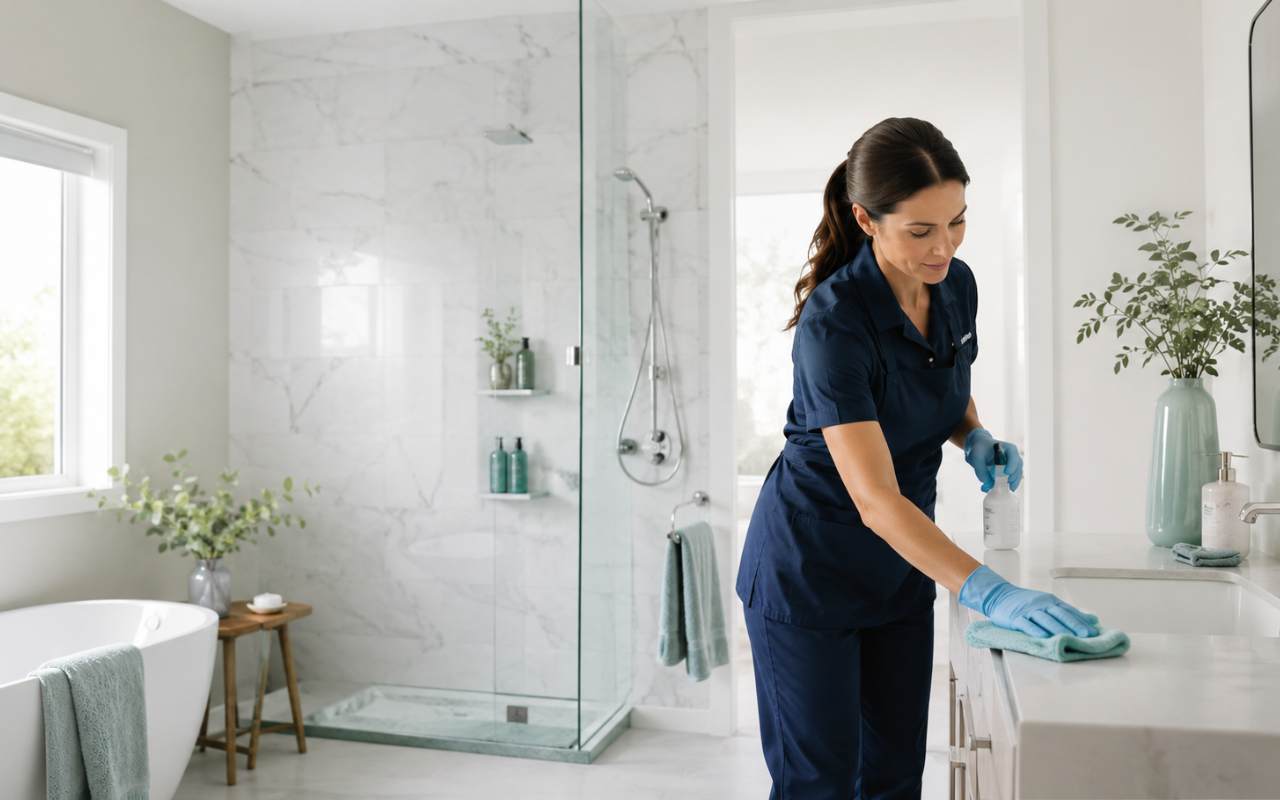
Deep cleaning a bathroom takes 45 to 90 minutes for a standard Toronto bathroom. A whole-home deep clean that includes the bathroom costs $220 to $555 before HST depending on home size. A proper bathroom deep clean goes beyond wiping surfaces — it means scrubbing grout, descaling the showerhead, cleaning behind the toilet, washing the exhaust fan cover, and getting inside the cabinet and under the vanity.
For a full room-by-room guide to deep cleaning your entire home, see our how to deep clean a house guide.
How Much Does Professional Bathroom Deep Cleaning Cost?
Bathroom deep cleaning is included in Houmse's whole-home deep cleaning service. Flat rates by home size — before HST, no hourly billing:
| Home size | Deep clean (before HST) |
|---|---|
| 1-Bedroom / 1-Bath | $220 |
| 2-Bedroom / 2-Bath | $320 |
| 3-Bedroom / 2-Bath | $345 |
| 4-Bedroom / 3-Bath | $555 |
Want the bathrooms done without doing them yourself? A Houmse deep clean covers every step in this guide, in every bathroom, for one flat price. See your exact price in 60 seconds — no payment upfront, same-week availability in Toronto and the GTA. Or see what's included on every Houmse deep clean, backed by the Houmse 24-Hour Re-Clean Guarantee.
How Often Should You Deep Clean a Bathroom?
Most bathrooms benefit from a thorough deep clean every 1–3 months. Weekly surface maintenance — toilet bowl, sink, and mirror — keeps things hygienic between deep cleans but doesn't replace the deeper work on grout, fixtures, and hard-to-reach areas.
Household composition shifts the frequency. Families with children or bathrooms shared among three or more people tend to need monthly deep cleans — higher daily use means faster buildup on grout lines, caulk, and shower surfaces.
The most reliable indicator is visible buildup: when grout starts to discolour, limescale appears on the showerhead, or surface wiping stops being enough, it's time for a deep clean rather than a quick wipe-down.
What You'll Need
Gather everything before you start — stopping mid-clean to search for supplies breaks momentum. These are bathroom-specific items; if you're deep cleaning the whole home, the full supplies list is in the house guide above.
- Toilet brush and disinfectant — dedicated brush; do not reuse for other surfaces
- All-purpose bathroom cleaner — tiles, sink, vanity surfaces
- Grout brush and grout cleaner — stiff bristle for grout lines; baking soda paste works as an alternative
- Mould/mildew cleaner or diluted bleach — for visible mould on caulk, grout, or shower edges
- Limescale descaler — showerhead soak, faucet aerator; white vinegar or commercial descaler
- Glass cleaner — mirror, shower door or screen
- Microfibre cloths (at least 3 sets) — toilet area, sink and mirror, general surfaces
- Old toothbrush — grout lines, faucet base, hinges, shower door track
- Rubber gloves — toilet and mould/bleach work especially
- Flat mop or floor scrubber — floor grout and tile cleaning
- Extendable duster — exhaust fan cover, light fixture above mirror
Step-by-Step: How to Deep Clean a Bathroom
Work through each area in order — toilet first (cleaner dwells while you do other surfaces), then shower, sink, and floors last. This sequencing minimises re-contaminating surfaces you've already cleaned.
Toilet
- Apply toilet bowl cleaner inside the bowl first — let it dwell 5–10 minutes while you clean other surfaces; do not flush yet
- Wipe the exterior — tank lid, tank, handle, and base — with a disinfectant cloth, working top to bottom
- Clean the seat (both sides) and hinges — disinfectant cloth; check underneath the seat and around hinge screws
- Scrub inside the bowl — toilet brush under the rim is where mineral deposits concentrate most
- Flush and wipe the bowl rim — final wipe of the rim and exterior surfaces after flushing
- Wipe behind the toilet and the wall behind it — dust and splatter accumulate here and are easy to overlook
- Clean the floor around the base — grout around the base and flooring adjacent to the toilet
Shower and Bathtub
- Spray shower walls, tub, and door with cleaner; let dwell 5–10 minutes — dwell time is the key step; do not skip or rush it
- Scrub tiles and grout lines with a grout brush — work horizontal and vertical lines; circular motion on heavy staining
- Clean shower door tracks or runners — old toothbrush and cleaner; the track is usually the most neglected area in the entire bathroom
- Descale the showerhead — fill a bag with white vinegar, submerge the head, secure with a rubber band; soak 1–3 hours (or overnight for stubborn deposits)
- Scrub tub surface and drain cover — remove the drain cover if possible and clean underneath
- Clean shower curtain liner — machine wash or replace; check care label; most people never wash it
- Rinse all surfaces; squeegee door and walls — squeegeeing immediately after cleaning prevents water marks from re-forming
Sink and Vanity
- Clear the countertop and wipe down items before replacing — remove and wipe the soap dispenser, toothbrush holder, and any other items
- Scrub the sink bowl and faucet; descale if needed — old toothbrush at the faucet base; white vinegar or descaler on the aerator
- Clean the mirror top to bottom — glass cleaner with a lint-free cloth; wipe the frame edge
- Wipe the light fixture above the mirror — when cool; dust buildup is most visible when the light is on
- Clean cabinet interior and exterior — remove all contents; wipe shelves and inside the door; check product expiry dates while you're in there
- Wipe the countertop and clean the soap dispenser base and toothbrush holder — soap residue accumulates at the base; scrub with an old toothbrush
- Organise and return items to the cabinet — replace only what you're keeping; discard expired products
Floors, Walls, and Grout
- Sweep or vacuum the floor first — remove loose hair and debris before mopping; skipping this step means mopping just moves debris around
- Scrub floor grout lines — grout brush and grout cleaner; let it dwell if heavily stained; circular motion produces the best result
- Mop the floor with disinfectant — work from the far corner toward the door; rinse the mop regularly
- Wipe baseboards — bathroom baseboards collect both dust and moisture; damp microfibre cloth
- Spot-clean walls for soap splash, toothpaste marks, and water stains — all-purpose cleaner; check wall material for compatibility before applying
- Clean the light switch plate and outlet covers — high-touch surfaces; disinfectant wipe
Areas Most People Skip
These are the spots that almost never appear in a routine bathroom clean — and that account for most of the buildup that makes a bathroom feel unclean even after a standard wipe-down.
- The exhaust fan cover traps dust quickly — remove it, wash under running water, let it dry before replacing. Dust buildup restricts airflow and reduces exhaust effectiveness.
- The overflow drain (bathtub and sink) almost never gets cleaned — unscrew the plate, clean it, and wipe the channel behind it.
- The shower curtain rod collects mildew at the rings and at both ends where moisture stays trapped — wipe the rod and replace corroded rings.
- Mould that has penetrated caulk lines is difficult to remove by scrubbing — recaulking may be the more effective solution. Keeping caulk intact and sealed prevents this buildup.
- Unsealed grout absorbs stains and mould — reseal every 1–2 years with a grout sealer to prevent future buildup.
- Under and behind the vanity cabinet: dust and hair accumulate here; vacuum first, then damp-mop.
- Light switch plates and outlet covers are high-touch surfaces that rarely get wiped — a disinfectant cloth takes under a minute and should be part of every deep clean.
When to Hire a Professional for Bathroom Deep Cleaning
Hiring makes sense when the scope, condition, or time constraint makes DIY the harder option — not because DIY can't work, but because the trade-off doesn't always make sense.
- Multiple bathrooms (2+) — time investment multiplies; a two-bathroom deep clean runs 90–150 minutes (estimates vary with buildup and bathroom size/conditions) of focused work.
- Heavy mould in grout or caulk — mould that has penetrated grout or caulk requires commercial products and technique; DIY products slow the spread but rarely eliminate it.
- Caulk needs replacement — recaulking is beyond cleaning scope; if caulk is visibly compromised, a professional clean typically includes a flag for recaulking.
- Move-out condition required — landlord-ready condition often requires a documented standard; the Houmse 24-Hour Re-Clean Guarantee provides a clean you can point to.
- Heavy limescale on fixtures — commercial descalers produce significantly better results on heavy limescale than consumer white vinegar solutions.
Every cleaner is background-checked, ID-verified, and carries $2M commercial liability insurance — backed by Houmse's own $2M policy on every booking.
Ready to book? Get your exact deep-clean price in 60 seconds — no payment upfront, same-week availability across Toronto and the GTA.
Frequently Asked Questions
Straight answers about standard and deep cleaning.
Have a different question? Contact us →

Mah Sadegh
Mah writes about home cleaning, Toronto living, and the small routines that keep a home calm and cared for — practical tips from real homes across the GTA.
About Mah SadeghRelated reads

House Cleaning Hourly Rates, Toronto (2026)
House cleaning in Toronto varies widely in cost depending on who you hire. Compare rate tiers by home size — and see why flat-rate pricing beats hourly every time.
Deep Clean vs Standard Clean: Which Do You Need?
Standard clean or deep clean? See exactly what each service covers, when to book each, and how pricing compares — so you choose the right service.
Affordable House Cleaning for Seniors in Toronto — Family Guide
Affordable home cleaning for seniors in Toronto and the GTA — from $136 a visit every two weeks. What's included, what it costs, funded options, and how families can set up a recurring plan for a parent.
Ready to book a cleaning?
Background-Checked & Insured · Same-Week Availability. Book in 60 seconds.
See My Price