

How to Deep Clean a House: A Room-by-Room Guide
Researched by the Houmse team · Published June 2026 · Updated August 2026 · 10 min read · Editorial standards
A full deep clean takes 4 to 8 hours for a typical Toronto home and costs $220 to $555 before HST if you hire it out. Deep cleaning covers every surface and space a standard clean skips — inside appliances, behind furniture, baseboards, grout lines, and air vents. Work room by room to avoid missing anything. For the full breakdown of what separates a deep clean from a standard clean, see our standard vs deep clean comparison.
How Much Does a Professional Deep Clean Cost?
Houmse prices deep cleans as a flat rate by home size — no hourly billing. Prices below are before HST and match our deep cleaning service ratecard.
| Home size | Deep clean (before HST) |
|---|---|
| 1-Bedroom / 1-Bath | $220 |
| 2-Bedroom / 2-Bath | $320 |
| 3-Bedroom / 2-Bath | $345 |
| 4-Bedroom / 3-Bath | $555 |
If you'd rather skip the 8-hour scrub, see what's included in a Houmse deep clean — same background-checked cleaner, same-week availability, and the Houmse 24-Hour Re-Clean Guarantee if anything is missed.
What You'll Need Before You Start
Gather everything before you start — stopping mid-room to find supplies breaks focus and extends the job. For most homes, the following covers a full deep clean from top to bottom.
- Microfibre cloths (at least 2–3 sets) — kitchen, bathrooms, and other surfaces
- All-purpose cleaner — most surfaces; kitchen counters, shelves, hard floors
- Bathroom disinfectant / scrub — tile, grout, toilet bowl
- Degreaser — kitchen; stovetop, hood vent, cabinet fronts
- Glass cleaner — windows, mirrors, TV screen
- Grout brush or old toothbrush — tile grout lines, faucet bases
- Mop and bucket — hard floors in kitchen, bathrooms, entry
- Vacuum with attachments — crevice tool (edges/corners), upholstery brush (sofa, mattress)
- Extendable duster — ceiling fans, light fixtures, top-of-shelf dust
- Rubber gloves — bathroom and kitchen sections especially
- Baking soda + white vinegar — (optional) natural alternatives for descaling and deodorizing
How to Deep Clean the Kitchen
The kitchen takes the most time of any room — grease and buildup accumulate on surfaces that standard cleans don't reach. Work from top to bottom and leave dwell-time products (oven cleaner, degreaser) to sit while you clean other surfaces.
- Clear and wipe all countertops — remove small appliances; wipe under and behind each one
- Clean inside the microwave — steam method (bowl of water + lemon, 5 min) or wipe with a damp cloth
- Degrease stovetop, burners, and hood filter — soak removable burner grates; wipe hood filter or run it through the dishwasher
- Clean inside the oven — self-clean cycle or manual baking soda + vinegar paste; leave to dwell 20 min before wiping
- Wipe cabinet fronts and handles — degreaser on cabinet fronts, especially around the stove area
- Clean inside the refrigerator — remove shelves and drawers, wash them, wipe door seals and gasket grooves
- Scrub sink and faucet; descale if needed — baking soda paste on stainless; vinegar soak for limescale on the faucet
- Clean dishwasher filter and door seal — remove filter, rinse under the tap; wipe door seal with cloth and disinfectant
- Sweep and mop the floor — pull fridge and stove out; vacuum behind; mop entire floor including corners
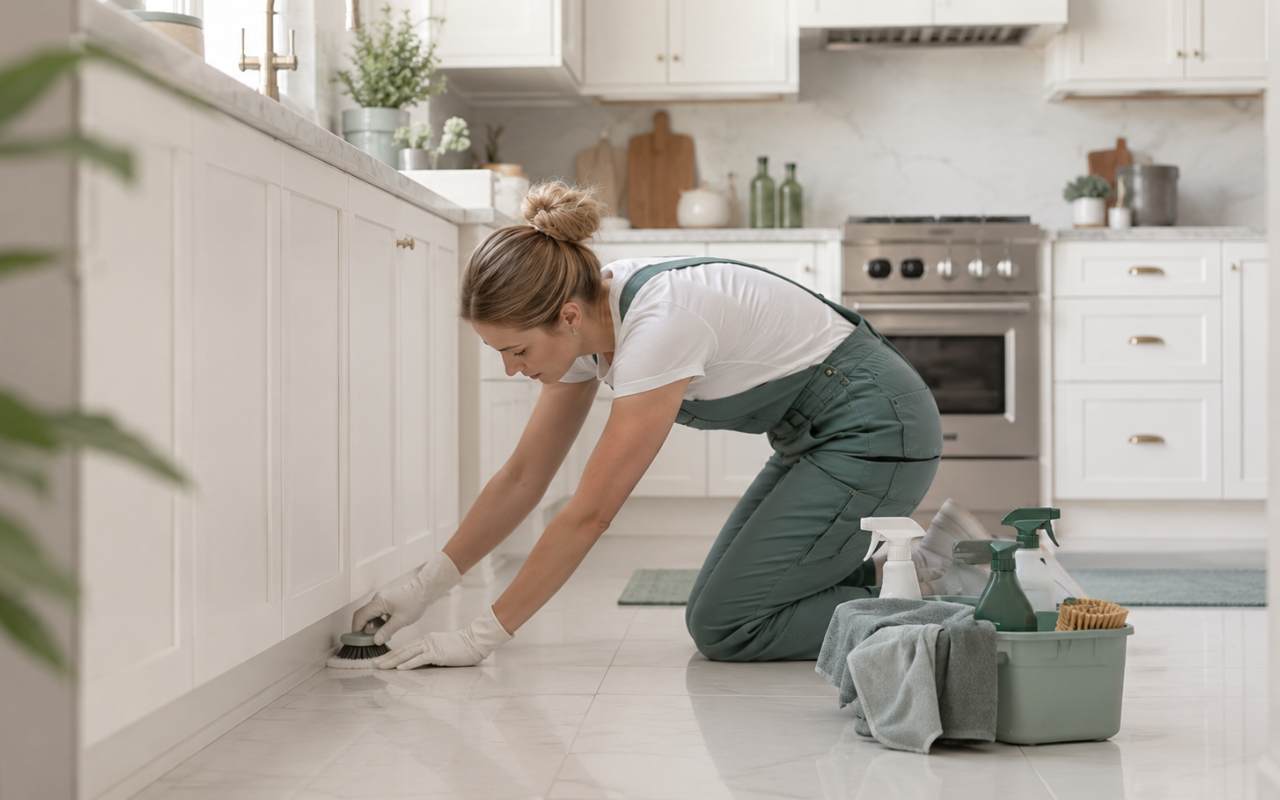
- Wipe baseboards and kickboards — often missed in standard cleans; a damp cloth is sufficient
How to Deep Clean the Bathrooms
Apply toilet cleaner at the very start so it dwells while you clean everything else — this is the most efficient sequencing for a bathroom deep clean.
- Apply toilet cleaner inside the bowl first — let dwell 5–10 minutes while cleaning other surfaces; do not flush yet
- Scrub tile grout with brush and cleaner — bathroom disinfectant or baking soda paste; let dwell 5 min then scrub
- Clean showerhead and shower door or curtain — descale showerhead with vinegar bag soak; scrub glass door; machine-wash fabric curtain if applicable
- Wipe cabinet interiors and exteriors — remove all contents; wipe shelves; check product expiry while cleaning
- Clean mirror — glass cleaner with a lint-free cloth; wipe frame
- Scrub toilet completely — bowl brush inside; cloth and disinfectant for seat, exterior, and behind the base
- Wipe sink, faucet, and counter — faucet base groove with a toothbrush; descale if limescale is visible
- Sweep and mop floor; clean baseboards and corners — get into corners behind toilet; wipe baseboards with a damp cloth
For a dedicated step-by-step bathroom walkthrough, see our bathroom deep cleaning guide.
How to Deep Clean the Bedrooms
Work top to bottom — ceiling fans and light fixtures first so any falling dust lands on surfaces you haven't cleaned yet.
- Wash all bedding, pillows, and duvet covers — check wash labels; follow care instructions for pillows and duvets
- Flip or rotate mattress; vacuum mattress surface — use upholstery attachment; deodorize with baking soda if needed
- Dust all surfaces top to bottom — nightstands, dressers, shelves; top first so dust falls to the floor
- Wipe baseboards and window sills — damp microfibre cloth; check window tracks for dirt buildup
- Clean inside wardrobe or closet — wipe shelves; vacuum closet floor including corners
- Vacuum under the bed; move furniture — pull out dressers and nightstands; vacuum behind
- Clean light fixtures and ceiling fan blades — wipe top of fan blades where dust accumulates; they release a cloud when the fan runs
- Vacuum or mop floors — carpet: vacuum edges with crevice tool; hard floors: mop after vacuuming
How to Deep Clean Living Areas and Common Spaces
This section covers the living room, dining area, hallways, and entry — anywhere that accumulates dust, high-touch surfaces, and floor traffic.
- Dust ceiling corners, light fixtures, and fan blades — extendable duster first so dust falls to the floor
- Wipe all hard surfaces — shelves, TV unit, side tables, coffee table; all-purpose cleaner
- Clean TV screen and remotes — microfibre only for the screen (no spray directly); disinfectant wipe for remotes
- Vacuum sofa cushions and underneath — remove cushions; vacuum underneath; wipe leather or apply fabric treatment if needed
- Clean interior windows and window tracks — glass cleaner for panes; stiff brush then damp cloth for tracks
- Dust and wipe baseboards room-wide — full-room baseboards in one pass; damp microfibre on groove
- Vacuum carpets and mop hard floors — crevice attachment along edges; move rugs to clean underneath
- Clean light switches and door handles throughout — high-touch surfaces; disinfectant wipe; do the entire home in one pass
Areas Most People Miss (And Shouldn't)
These are the areas that almost never get touched in a standard clean — and that professionals clean as a matter of course.
- Baseboards collect dust in the groove along the top — wipe with a damp microfibre cloth in one pass room-by-room.
- Air vents and registers trap dust inside the channel — remove the cover, vacuum the inside, then wipe the cover before replacing.
- Light switches, outlet covers, and door handles are high-touch surfaces that rarely get wiped — a disinfectant wipe takes under a minute for the whole home.
- Behind and under large appliances (fridge, washing machine, dryer) should be cleared once a year — lint behind the dryer is a fire risk.
- Inside the washing machine drum and detergent drawer: run a hot empty cycle with machine cleaner and scrub the detergent drawer under the tap.
- Window tracks build up grime in the channel — use a stiff brush first, then a damp cloth to wipe clean.
- Ceiling fan blade top surfaces accumulate dust that falls as a cloud when the fan runs — wipe the top of each blade before turning it on.
- Cabinet and drawer interiors in kitchens and bathrooms should be emptied, wiped, and restocked with only what you're keeping.
- Shower curtain liners are machine-washable on most models — check the label; most people never wash them.
When It Makes Sense to Hire a Professional
Hiring makes sense in specific situations — not because DIY is wrong, but because the scope or constraints make it the practical choice. Readers who DIY today often become customers when circumstances change.
- Home is 3+ bedrooms — a full deep clean takes 7–10 hours solo; a professional team covers it in 3–4 hours working in parallel.
- Move-in or move-out — move deadlines don't wait; a professional team delivers a clean to a documented standard in a single visit.
- Haven't deep cleaned in 6+ months — backlog cleans take significantly longer than maintenance deep cleans; the first deep clean is always the hardest.
- Physical limitations or time constraints — if the scope genuinely isn't doable given your schedule or physical capacity, hiring is the practical choice.
- Want a guaranteed result — Houmse's deep cleaning service includes the Houmse 24-Hour Re-Clean Guarantee — if anything is missed, we come back.
Every cleaner is background-checked, ID-verified, and carries $2M commercial liability insurance — backed by Houmse's own $2M policy on every booking.
Ready to book? Get your exact deep-clean price in 60 seconds — no payment upfront, same-week availability across Toronto and the GTA.
Frequently Asked Questions
Straight answers about standard and deep cleaning.
Have a different question? Contact us →

Mah Sadegh
Mah writes about home cleaning, Toronto living, and the small routines that keep a home calm and cared for — practical tips from real homes across the GTA.
About Mah SadeghRelated reads
How to Deep Clean an Apartment: Room-by-Room Guide
Room-by-room deep clean steps for apartments, a move-in prep checklist, and GTA pricing from $220 for professional service.
Do House Cleaners Bring Their Own Supplies and Equipment?
Most cleaning companies bring their own products, but vacuum policies differ. What's included, what you supply, and what to ask about pets and allergies.
House Cleaning Hourly Rates, Toronto (2026)
House cleaning in Toronto varies widely in cost depending on who you hire. Compare rate tiers by home size — and see why flat-rate pricing beats hourly every time.
Ready to book a cleaning?
Background-Checked & Insured · Same-Week Availability. Book in 60 seconds.
See My Price